Link's Redwood
My good friend and master cabinet maker Link Van Cleave told me a while back that he recently got some well aged salvaged old growth redwood boards and wondered if I would be interested in the smallest board for ukulele tops. The piece was well quartered with no runnout and I was delighted to get it. The color and tightness of grain were exceptional so I quickly sawed it into two tops that had a nice ring and were quite stiff.
Some think that you have to buy tonewood from a reputable dealer in order to make a fine instrument. That is often not the case for an experienced builder who knows what he is looking for. Certainly a tonewood dealer has taken a lot of the guesswork out of buying wood but there are lots of ways to find instrument worthy wood. This is a good example.
I have worked with redwood before and I'm very picky about what will result in a quality instrument. While I liked the taptone of Link's redwood the finished tonal presence was even better than I expected. The individual notes are clear and warm and there is a shimmer to the trebles that I'm always striving for. It's a product of the overtones and sustain created by my X-bracing design. This is a sensitive instrument but one with plenty of headroom for strumming.


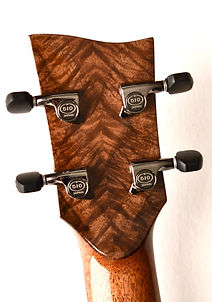
I saved the most dramatic walnut for the head plate and back plate of the headstock. The Honduran mahogany for the neck I've had for over twenty years.
The tuners are Gotoh SGi510s with a 16:1 ratio. They are sized nicely for ukuleles and work effortlessly. They have thicker Gotoh "rock solid" posts that are better for ukuleles than the posts of the Gotoh UPTs. I swapped out the metal buttons for some ebony ones. The finish on the tuners is a beautiful cosmo black and it's on the Gotoh strap buttons as well.
The strap button on the neck heel is attached by a bolt that screws into a threaded insert in the heel block of the body. There is another threaded insert in the heel that attaches to the neck with a bolt through the inside of the body. The freboard extension is glued to the top.

I decided to limit the color palette for this rosette. It's made with a combination of black and birch veneers with an inner ebony binding. That combination is also used for the purfling and binding of the body.
The walnut for the back and sides compliments the redwood top. The two woods look and sound great together. The redwood is bright and crisp while the walnut is warm and woody. The black walnut in this Ken Franklin tenor comes from Oregon. While it doesn't have the varied colors of claro walnut it has a beautiful broken curl that I appreciate. Black walnut also rings more than claro and goes well with the limited palette of the rosette and bindings.

There is a side soundport in the upper bout that is reinforced with decorative laminated veneers. It provides an acoustic monitor for the player and helps minimize the helmholtz resonance of the top for a more even tonal response.
The sides have hand carved laminated linings that are notched into the heel and tail blocks. This adds to the rigidity of the sides which helps couple the top and back plates work together.


Braces are Engelmann spruce, hand carved throughout the voicing process to produce a desired tonal response. On custom instruments for an individual player I can tailor these to the player's needs. Here I have shaped them for what I think will be the best overall response for most people.
The scale length is 17 inches. The string spacing on the intonated unbleached saddle is 1 23/32 inches from G to A. The unbleached bone nut is 1 1/2 inches.
Strings are Jason Arimoto PHDs with a GHS winter silver wound low G. I find the GHS low G to be the best sounding low G for my ukuleles though others might last longer.
There is a thin high gloss catalyzed urethane finish with a clear pickguard. This Ken Franklin tenor comes with a durable GEARLUX wooden hard case. $6800 Sold


