African Blackwood
I had success using California sycamore for the top on a recent tenor build. The tone was unique and inviting. It had forest red gum back and sides which I thought might be a contributing factor. So I wondered how the sycamore would work with rosewood. I'm fortunate to have several old sets of African blackwood and I thought the combination would be intriguing both aesthetically and tonally. The results were better than I expected. This blackwood is quartersawn with an attractive sapwood strip in the center. Like most rosewoods it has a ringing tap tone but this set has more lingering sustain than most. The downside might be that it's quite dense. Even after thinning the plates to my usual thicknesses the body was heavier than most of my builds. It doesn't bother me much but it might bother some. The trade off is the incredible tone.
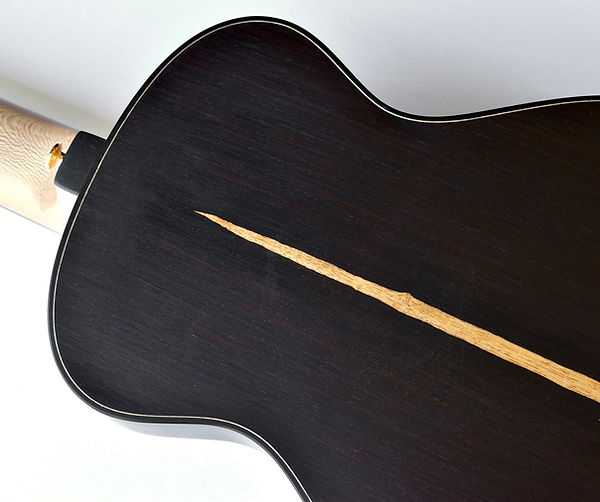

I decided to accent the blackwood with a simple birch purfling line since the highly figured California sycamore top would draw a lot of attention. I often like to limit the number of elements that attract focus and overly complicate the design but this time I went all in. Well, for me all in. So I made new rosette tiles with blackwood, sycamore and birch. Then I used an ebony fingerboard with handsome sapwood streaks. This is about as fancy as I get but it all seemed to work together at least to my eye. There's also a reinforced oval soundport to enhance the player's experience. I usually include one in all of my builds.
I made an ebony bridge with an unbleached intonated bone saddle but I resisted the urge to make an ebony faceplate which might have been too much black. I used sycamore instead as it echoes the top nicely. There's also a sycamore backplate on the sycamore neck. The SGi510 Gotoh tuners with a 16:1 ratio in gold finish and custom ebony buttons look great and function beautifully.

A few other thoughts... The frets are StewMac gold with rounded polished fret ends. The penetrating satin finish is UV cured. There is a clear pick guard to protect the top. The linings are bent and laminated. They are notched into the neck and tail blocks and then carved in place. The strap buttons are Gotohs in gold finish. The neck button is attached with a bolt that screws into a threaded insert in the neck block. It's important not to remove this strap button since it is one of two bolts that hold on the neck. This African blackwood tenor is protected by a durable wooden case. It's headed for The Ukulele Site in Hawaii. $6800


Working with sycamore tops has been eye-opening . The material used for stereo speakers has little resonance of its own. It merely responds to the impulse it's given. I'm guessing that is similar to what a sycamore top does. It doesn't have a rich ringing tap tone. It's rather dull when tapped but the advantage might be the uniformly sensitive response in the finished ukulele especially when paired with Jason Arimoto PHD strings and a Pepe Romero smooth wound low G. There is beautiful warmth and good clarity but the power must be coming from the bracing system and the back and sides. So it is more of a challenge to choose and carve the braces while creating a sycamore top. I tap the top continually during this process listening for an optimal response.


